

Brent over $103: Trump-Iran Standoff Reignites Oil Prices
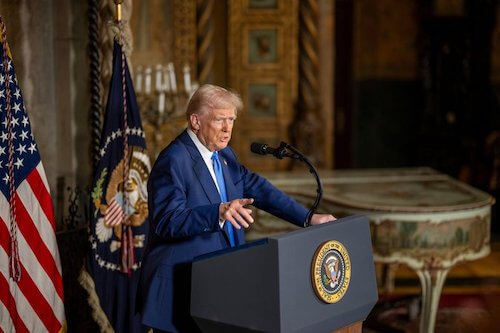
Iran-Trump Standoff: Brent Crude Above $103
The energy market remains dominated by the standoff between Washington and Tehran. Iran is demanding an end to the war in the Middle East, the lifting of the blockade on its ports, and the release of frozen assets, demands that Donald Trump has called « totally unacceptable."
This deadlock keeps significant pressure on oil prices. Brent crude stands at $103.56, up by $2.27 for the session, an increase of 2.24%. This marks a sharp contrast with the end of last week, when Brent had plummeted below $99 in hopes of a US-Iran agreement.
The Strait of Hormuz remains the main vulnerability for global hydrocarbon supply. Several Western capitals are discussing securing navigation, without any short-term operational solution. This ongoing risk continues to fuel the geopolitical premium factored into prices.
China: Producer Prices Revive the Risk of Imported Inflation
The energy shock is starting to show up in macroeconomic indicators. In China, producer prices rose by 2.8% year-on-year in April, marking their highest increase since July 2022.
This acceleration is closely monitored by international investors. As China is a central supplier of intermediate goods and manufactured products, a sustained rise in its factory gate prices could be passed on to European and American imports.
This context revives the risk of imported inflationary pressures, which could complicate central banks' expectations of rate cuts. For bond portfolios and interest rate-sensitive stocks, this data weighs on the expected trajectory of monetary policy.
Trump-Xi Summit: A Packed Agenda for Cyclical and Tech Sectors
Beyond the energy issue, the anticipated summit between Donald Trump and Xi Jinping is drawing attention. Discussions are expected to cover Iran, but also tariffs, Taiwan, artificial intelligence, and critical minerals.
This dense agenda adds an element of uncertainty for the markets. Tariffs directly impact the margins of exporting industries, while the Taiwan issue affects semiconductor supply chains, the heart of the global technological ecosystem.
Critical minerals and artificial intelligence also represent two key areas of structural technological rivalry. According to cited sources, these topics could weigh on risk appetite, particularly for cyclical and technological stocks. Variables to monitor remain the Brent crude oil prices, the situation around Hormuz, and diplomatic signals from the summit.
This content has been automatically translated using artificial intelligence. While we strive for accuracy, some nuances may differ from the original French version.


