

Eurodrone: Behind the Airbus-Dassault Conflict, €1.2 Billion at Stake
Dassault Aviation has initiated arbitration proceedings against Airbus following its expulsion from the Eurodrone program. The French manufacturer had been awarded a share of work valued at 1.2 billion euros when the contract was launched in 2022. Four years later, the reorientation of French military orders is disrupting the industrial balance of this 7.1 billion euro European program. For investors, the challenge is to assess the financial consequences of this breach, as the amount of compensation being claimed remains unknown.
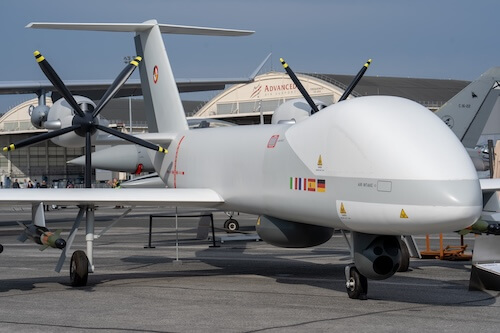
Dassault was supposed to undertake €1.2 billion in work on Eurodrone
The dispute between Airbus and Dassault Aviation over the Eurodrone program has now been taken to arbitration. According to information revealed by La Lettre on November 13, 2026, the French manufacturer has initiated proceedings to seek financial compensation after being excluded from the development of the European drone.
Éric Trappier, Chairman and CEO of Dassault Aviation, discussed this issue on Sunday, November 15, during the Grand Jury RTL-Public Sénat-Ouest France.
The conflict revolves around a major military program whose features and commercial prospects have significantly evolved since its initial signing. A single figure highlights the importance of the initial contract for Dassault: 1.2 billion euros worth of work had been allocated to the company.
This amount stems from a statement made by Éric Trappier on March 4, 2022, during the presentation of Dassault Aviation's 2021 annual results. The executive had specified that his company was to receive 1.2 billion euros out of the total 7.1 billion euros of the overall contract.
Dassault was responsible for developing the flight controls of the aircraft and participated in the architecture of its communication systems, notably with Thales. These systems play a central role in a remotely piloted drone, where communications between the aircraft and ground stations must be secure and reliable.
The total envelope of 7.1 billion euros excluding taxes was notified in February 2022 by the Organisation for Joint Armament Cooperation (OCCAR) to Airbus Defence and Space GmbH, the lead contractor for the program. It covered the development, production of twenty systems, each comprising three drones, and five years of initial support.
The portion announced by Dassault represented about 17% of the initial contract. It gives a sense of the scale of its industrial involvement but does not allow for the calculation of the damages resulting from its exclusion. Part of the work may have been completed since 2022, and the amount of unfulfilled commitments is not publicly established.
How the French decision disrupted the program
Initially, France planned to acquire four Eurodrone systems, totaling twelve aircraft, with the option to purchase two additional ones. However, lessons from recent conflicts, particularly in Ukraine, have shifted the priorities of the French military.
In its report on drone warfare dated July 7, 2026, the Senate's Foreign Affairs and Defense Committee notes that the updated military programming law removes the acquisition targets initially set for 2030 and 2035.
French military authorities are questioning the alignment between the Eurodrone's characteristics, its cost, and the operational needs revealed by high-intensity conflicts. The Ukrainian experience specifically highlighted the growing importance of relatively inexpensive drones, produced in large numbers and capable of being lost in combat.
This shift in doctrine occurs even as the program had already advanced several industrial stages. Its critical design review was completed in October 2025, according to OCCAR, paving the way for prototype manufacturing and ground tests.
However, a crucial distinction remains: the removal of France's acquisition targets does not necessarily imply a legal withdrawal from all its commitments. As of July 2026, the Senate specified that no formal withdrawal had occurred at that time. Therefore, the exact status of French commitments should be distinguished from the decision not to proceed with the procurement of the equipment.
This situation places manufacturers in a difficult position. Work had been distributed and initiated based on a multinational program, of which one of the main participating states no longer wishes to acquire the initially planned equipment.
The Industrial Sharing Mechanism at the Heart of the Dispute
It is precisely this change in orders that explains part of the conflict between Airbus and Dassault.
In an investigation published on June 11, 2026, Reuters indicated, based on three sources familiar with the matter, that the French withdrawal was expected to lead to a reduction in the workload assigned to French manufacturers.
European defense programs traditionally rely on the distribution of activities among participating countries, following a mechanism known as geographical return. National contributions and orders thus influence the distribution of industrial contracts. A decrease in French acquisitions could challenge the share of work initially allocated to Dassault.
According to Reuters, the manufacturer was seeking compensation since June for part of the investments potentially lost due to this redistribution.
The disagreement became public on July 1st. During a hearing before the Senate Foreign Affairs and Defense Committee, Éric Trappier indicated that Airbus had asked Dassault to leave the program, a decision he was contesting.
Airbus's position was later clarified by the Minister of the Armed Forces, Catherine Vautrin. During a parliamentary hearing reproduced in a National Assembly report recorded on October 22, 2026, she confirmed that Airbus had requested a contract revision and decided to exclude Dassault from the subcontracting, with the announced aim of improving the program's efficiency.
The dispute therefore is not solely about differing views on the future performance of the Eurodrone. It also involves the contractual and economic consequences of an industrial reorganization.
What are the financial implications for Airbus and Dassault?
The initiation of arbitration raises several questions for shareholders: the amount of any compensation that might be due, the costs associated with reorganization of the program, and the potential impact on future results.
At this stage, no specific claim amount has been confirmed publicly. It would therefore be incorrect to equate the initially anticipated 1.2 billion euros worth of work by Dassault with a financial loss or potential compensation.
To put the matter in perspective, as of June 30, 2026, Dassault Aviation had an order backlog of 45.36 billion euros, primarily driven by the Rafale and Falcon programs. The group achieved 4.16 billion euros in adjusted revenue for the first half of the year, reflecting a 46% year-on-year growth.
Its adjusted operating profit reached 330 million euros, compared to 180 million a year earlier, according to the half-year results published on July 22, 2026.
The Eurodrone contract thus represents only a portion of the group's activities, dominated by the Rafale and Falcon programs. However, the breakup could deprive Dassault of future revenue and raise the question of recovering the already incurred expenses. The real significance of this effect will depend on the services executed, those remaining to be carried out, and the contractual stipulations.
For Airbus, the issue also needs to be framed within the context of its Defence and Space accounts, its military and space division.
In the first nine months of 2026, this division generated 9.34 billion euros in revenue, up 5%, and 672 million euros in adjusted operating profit, compared to 420 million in the comparable period of 2025.
The division simultaneously recorded 11.47 billion euros in new orders, according to the financial statement released by Airbus on October 28, 2026.
The Eurodrone dispute thus arises within a growing sector. However, public data available does not allow for the isolation of its impact on the division's results or to determine if a specific charge related to this procedure will need to be accounted for.
First Flight Now Expected in 2029
The continuation of the program is another key factor for Airbus.
In June 2026, the company indicated that the first flight of the Eurodrone, now also designated as U950, was scheduled for 2029. This timeline confirms a significant delay compared to the project's initial ambitions, which envisioned entry into service in the mid-2020s.
Nonetheless, Airbus defends the aircraft's features, designed for long-endurance missions.
According to the manufacturer, it can remain in flight for up to forty hours and carry up to 2.3 tons of mission payload.
The group is also looking to develop new markets, particularly in maritime surveillance.
On June 26, 2026, Airbus announced the signing of a memorandum of understanding with Kawasaki Heavy Industries to study a version of the Eurodrone intended for anti-submarine warfare.
Japan has been participating in the program as an observer since 2023, but this exploratory agreement does not constitute a firm order.
Airbus's ability to maintain its European partners, adhere to the new schedule, and secure potential additional contracts will determine the commercial prospects of the program.
After the SCAF, a new challenge for European cooperation
The Eurodrone dispute arises amidst significant tensions between Airbus and Dassault.
In June 2026, France and Germany faced the impossibility of jointly continuing the development of their next-generation fighter jet, the NGF, a central component of the Future Combat Air System (FCAS). The two companies could not agree on governance modalities and the distribution of industrial responsibilities.
The FCAS and Eurodrone projects remain distinct, particularly from a contractual standpoint. However, they highlight the same difficulty: managing large joint military programs when national priorities and industrial interests diverge.
The Eurodrone program is based on a multinational contract that requires a lasting agreement on military needs, funding, and the allocation of work. A change in any of these elements can lead to complex contractual discussions, even when the aircraft's development continues.
The dispute between Dassault and Airbus thus illustrates the possible economic consequences of divergences between client states and industries in major European defense programs.
What Investors Should Watch Now
For Airbus and Dassault Aviation shareholders, four developments warrant particular attention: the outcome of arbitration, possible financial consequences of the industrial reorganization, clarification of commitments from participating countries, and technical advancements enabling the first flight deadline in 2029.
An unfavorable arbitration decision for Airbus could result in compensation, the amount of which is currently impossible to assess based on public information. Conversely, for Dassault, a favorable outcome may allow recovery of part of the investments or claimed contractual rights, without necessarily compensating for all initially planned work.
Beyond this procedure, Airbus must continue developing an aircraft where costs, schedule, and order prospects are subject to questioning. The existence of an initial contract worth 7.1 billion euros does not alone guarantee the program's profitability, which also depends on execution costs, potential amendments, and implementation conditions.
At this stage, the situation does not allow for a conclusion of significant impact on the stock market valuation of either manufacturer. However, it highlights an inherent risk in multinational defense programs: a multi-billion-euro contract may see its economic balance challenged several years after signing, as military needs and acquisition decisions evolve.
This content has been automatically translated using artificial intelligence. While we strive for accuracy, some nuances may differ from the original French version.


