

EU-Indonesia: Trade Agreement Signed to Eliminate 98.5% of Indonesian Tariffs
Over 600 million euros in customs duties saved each year
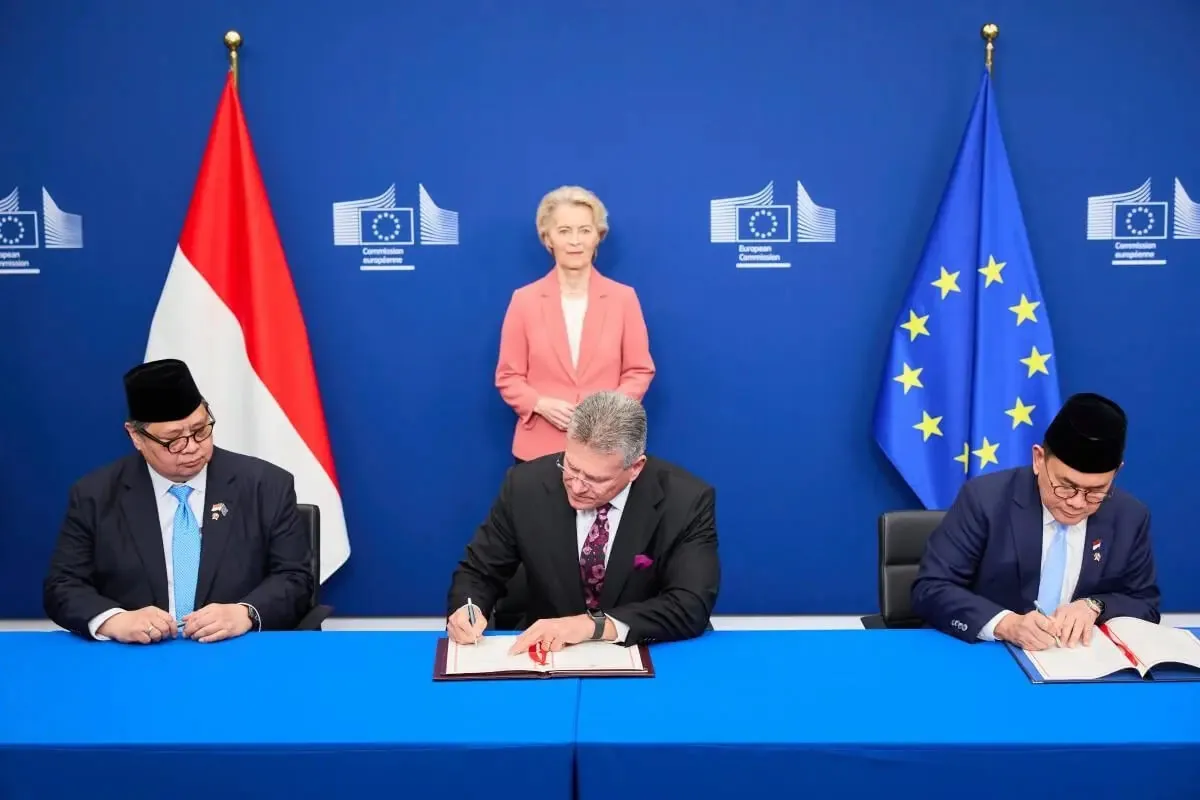
Ten years after the start of negotiations, the European Union and Indonesia have reached a decisive milestone in bringing their economies closer together. Signed on Saturday, November 21 in Brussels, the Comprehensive Economic Partnership Agreement (CEPA) and the Investment Protection Agreement (IPA) aim to facilitate trade with Southeast Asia's largest economy. Negotiations began in July 2016, and their conclusion was announced on September 23, 2025.
According to the European Commission, the CEPA plans for the elimination of Indonesian tariffs on 98.5% of tariff lines concerning European goods. This proportion corresponds to the product categories targeted by the liberalization, not the share of European exports that would become immediately duty-free. The opening will be gradual, with 96% of Indonesian tariffs expected to disappear within five years of the agreement's implementation.
Brussels estimates that European exporters could potentially save more than 600 million euros annually in customs duties. Conversely, the Indonesian government states that 90.4% of the tariff lines applicable to its products will benefit from duty-free access to the European market as soon as the agreement is applied. Additional reductions will occur progressively.
Goods trade between the two partners amounted to 28.9 billion euros in 2025, according to the Commission, including 10.2 billion in European exports and 18.7 billion in imports from Indonesia. This rapprochement thus takes place within a trade relationship that is still relatively modest considering the size of the two economies.
Automobiles, Pharmaceuticals, and Machinery: The Impacted European Sectors
The European industry is among the main sectors likely to benefit from the agreement. Indonesian tariffs on automobiles, which can currently reach up to 50%, are set to be mostly eliminated over a period of five years. Machinery and electrical equipment will also benefit from a gradual opening, with a large portion of duties expected to disappear as soon as the agreement is implemented.
Pharmacy and chemistry are also involved. According to the provisions presented by the Commission, tariffs on pharmaceutical products will mostly be eliminated from the start of the implementation, with the remaining ones set to disappear after three years. The remaining duties on chemical products are primarily to be eliminated within five years.
The agreement is not limited to customs tariffs. In the automotive sector, it includes the recognition of certain European certifications to reduce additional testing and certification requirements upon entering the Indonesian market. In electronics and industrial equipment, the recognition of certificates and test reports issued by accredited European bodies should also facilitate trade.
Agri-food is another important aspect. Dairy products, meats, fruits and vegetables, and processed products will benefit from a reduction or elimination of tariffs. The text also provides for the protection of 221 European geographical indications in Indonesia. These provisions aim to improve market access while protecting origin designations.
Investments and Commodities: A Challenge for Industrial Diversification
Beyond exports, the two agreements are part of the European strategy to diversify trade partnerships and supply chains. Indonesia holds a significant position in mineral resources and industrial processing activities in Southeast Asia. The CEPA notably includes provisions regulating the export restrictions of raw materials, the transparency of authorization procedures, and cooperation in energy sectors.
A separate agreement, focused on investment protection, aims to enhance the legal security of capital committed by both parties. It includes guarantees against certain unlawful expropriations and discriminatory treatments, while preserving the authorities' right to regulate for public interest reasons. Electric vehicles, renewable energies, and electronics are among the areas where Brussels seeks to facilitate investments.
The goal is also to strengthen an already established financial relationship. According to the European Commission, the EU's stock of direct investments in Indonesia reached 24.7 billion euros in 2024. The new provisions could improve the conditions for the establishment of European companies, though they alone do not guarantee new investments.
Palm Oil: A Specific Protocol on Sustainability
Palm oil, a sensitive topic in trade relations between Brussels and Jakarta, is subject to a specific protocol. This protocol organizes a dialogue on regulatory developments and establishes a framework for cooperation aimed at promoting more sustainable production and facilitating the exchange of goods from this sector.
The CEPA also includes a chapter dedicated to trade and sustainable development, with commitments related to the environment, climate, and workers' rights. The Paris Agreement is recognized as an essential element of the partnership.
These provisions do not mean that European sustainability requirements are disappearing. On the contrary, the framework aims to support trade openness through regulatory and environmental cooperation. The concrete implementation of these commitments will be one of the aspects to monitor after the agreement comes into force.
Implementation planned for early 2027, economic projections through 2042
The signing does not immediately change tariff conditions for trade. The agreements must still pass through their institutional phases. Within the European Union, approval by the European Parliament is necessary before their formal conclusion by the Council. Their provisional application also depends on the completion of the required internal procedures on both sides. The European Commission envisions this phase by early 2027, although no definitive date is set.
The timetable is particularly important for Jakarta. The Council of the European Union emphasizes that Indonesia must exit the European generalized system of preferences on January 1, 2027, which will end the tariff benefits currently enjoyed by certain Indonesian exports under this arrangement.
In the longer term, Brussels projects an additional GDP of around 16 billion euros for the European Union and 27 billion for Indonesia by 2042, compared to a trajectory without the agreement. These figures stem from economic modeling: they do not correspond to already realized gains or guaranteed annual amounts.
For businesses and investors, three parameters will now determine the scope of the rapprochement: the effective date of application, the pace of tariff reductions across sectors, and the ability of companies to expand their trade and investments. The reduction of duties represents a potential improvement in trade conditions, but its effect on the results of the concerned groups will also depend on exchanged volumes, costs, and competition. The signing thus marks a new phase in economic relations between Europe and Indonesia, with financial consequences that will be measured gradually.
This content has been automatically translated using artificial intelligence. While we strive for accuracy, some nuances may differ from the original French version.


