

Evolving Office Spaces: Cities Adapt
Companies are reinventing their workspaces, making them less extensive but more strategic, within a tertiary market undergoing significant requalification. The ADI 2025 barometer reveals a fundamental trend: office real estate isn't disappearing; it's transforming to adapt to the post-hybrid world.
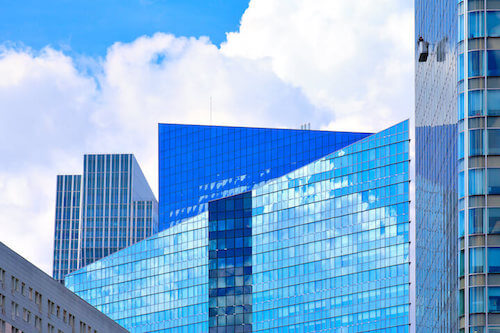
Offices Adapt to the Hybrid World
The rise of telecommuting and the increasing prominence of new collaborative methods have significantly disrupted the French commercial real estate market. According to the ADI 2025 Barometer on commercial real estate developments, companies continue to invest in office spaces, but with greater selectivity and strategic intent. Major metropolitan areas — Paris, Lyon, Marseille, and Bordeaux — are seeing the majority of relocations, with an 8% increase in newly established spaces over the past year. However, the occupancy logic is shifting: headquarters are being reimagined as places of collective experience, embodying corporate culture and acting as brand showcases.
The post-COVID period has accelerated awareness: owning a large amount of square footage is no longer a sign of strength. Real estate departments are now focusing on usability quality, space flexibility, and environmental performance. The office is becoming a human resources and strategic tool, not merely a cost. The goal is no longer to house all employees, but to create spaces where teams are eager to gather, interact, and innovate.
Operators also observe a phenomenon of market polarization: on one hand, there is strong demand for newly constructed, connected buildings that are well-located and have high energy efficiency (HQE, BREEAM); on the other hand, outdated, energy-intensive, or poorly accessible buildings are rapidly depreciating. This duality is reshaping territorial balances and accelerating the differentiated valuation of the commercial real estate portfolio.
A Market Reinventing Itself Through Quality
Investors have recognized that the future lies in the requalification of existing assets. Low-carbon renovation projects and the transformation of old buildings into « next-generation » offices are on the rise. This shift indicates a change in era: returns no longer depend on the number of square feet leased but on the ability to offer a comprehensive experience—sustainable, technological, and service-oriented.
Studies conducted by major real estate firms (CBRE, JLL, BNP Paribas Real Estate) confirm that companies are willing to pay a premium for buildings with strong environmental ratings, even if it means renting less space. Prime rental values in central business districts are still increasing, while energy-inefficient buildings experience skyrocketing vacancy rates. This structural movement aligns with Europe's path toward decarbonizing commercial buildings: the European « EPBD » directive will require, as of 2030, enhanced energy standards for all public and private buildings.
Local authorities are supporting this transformation by launching sustainable commercial development zones, like the Part-Dieu in Lyon or Euroméditerranée in Marseille. These mixed-use hubs combine offices, housing, retail, and services in a « compact city » approach. Tertiary sectors here become a driver of urban attractiveness, a catalyst for innovation rather than a symbol of centralization.
Tertiary Investment: Balancing Resilience and Transformation
For institutional investors, this restructuring opens up a new horizon of profitability. Yields are stabilizing around 4% to 4.5% for prime properties, but the gap between high-performing and secondary assets is widening significantly. The market now rewards selectivity: an asset that is well-positioned in terms of energy efficiency and functionality continues to attract tenants and funding, while standard offices are losing value.
This dynamic supports the emergence of a new profile of investors: impact real estate funds, management companies specializing in energy renovation, and green finance players. The goal is no longer just immediate profitability but responsible long-term value creation.
In a context where the cost of debt remains high, transforming the commercial property sector becomes a collective challenge: modernizing rather than building anew, requalifying rather than speculating.
Thus, far from being doomed, French offices are experiencing large-scale creative destruction. The model of the single-function tower is giving way to hybrid, sustainable, and human-centered real estate, reflecting ongoing social and economic changes.
This content has been automatically translated using artificial intelligence. While we strive for accuracy, some nuances may differ from the original French version.


