

Greenland: Trump threatens 10% to 25% tariffs against several European countries
US President Donald Trump announced on Saturday the imposition of a 10% tariff on exports to the United States from eight European countries, including France, effective February 1, 2026. These measures, linked to their opposition to the sale of Greenland to the United States, could rise to 25% in June. Europe is rallying in response to this unprecedented pressure.
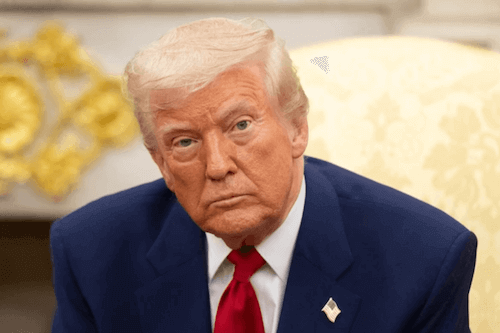
Targeted Countries and Timeline for Announced Tariffs
Donald Trump has targeted eight European countries for these trade sanctions: Denmark, Norway, Sweden, France, Germany, the United Kingdom, the Netherlands, and Finland. These countries have deployed military forces in Greenland, a self-governing Danish territory, as a show of support against the American ambitions for annexation. The 10% surcharge will take effect on all goods exported to the United States starting February 1, with an increase to 25% planned for June 1 if no agreement is reached for a 'complete sale' of Greenland.
This decision, revealed through a post on Truth Social, is part of Trump's recurring rhetoric since his return to power, citing national security reasons and highlighting Russian and Chinese influence in the Arctic. The targeted countries export tens of billions of euros annually to the United States, making these taxes potentially costly for their economies. France, for example, sees its agri-food and industrial sectors directly threatened. European financial markets have reacted with nervousness, with stock exchanges showing declines on Monday morning. Trump explicitly conditions the removal of the taxes on a full transfer of the territory, describing European opposition as an 'unacceptable risk' to world peace.
Immediate Responses and European Unity in the Face of the Threat
The announcement caused shock in Europe. An emergency meeting of EU ambassadors was held on Sunday in Brussels, followed by an exceptional summit of the 27 heads of state scheduled in the coming days, potentially Thursday. Emmanuel Macron stated that he would request the activation of the EU's anti-coercion instrument, a tool that requires a qualified majority to freeze access to European public markets or block American investments.
Italian Prime Minister Giorgia Meloni called Trump to describe this approach as a mistake. Danish Foreign Minister Lars Løkke Rasmussen affirmed a 'strong support from Europe,' emphasizing that the global order and NATO are at stake. Antonio Costa, President of the European Council, confirmed the imminence of the summit. The EU also has countermeasures ready: tariffs on 93 billion euros worth of American products, agreed upon in July 2025.
Geopolitical and Commercial Stakes in the Shadow of Greenland
At the heart of this crisis lies Greenland, a strategic Arctic island coveted for its position against Russian and Chinese threats. Trump ties tariffs to a 'comprehensive agreement' for its acquisition, challenging the July 2025 EU-US trade agreement, which was already deemed unbalanced: 15% tariffs on European imports (50% on steel and aluminum) versus zero on American goods. Maroš Šef?ovi?, the trade commissioner, now considers its implementation 'very complicated.' Initially hesitant, European Parliament members are postponing any vote on this agreement.
This escalation tests NATO, a 76-year-old alliance, and transatlantic unity beyond trade exchanges. Europeans, feeling 'shaken,' perceive it as a form of economic warfare, with a sense of helplessness if the United States deploys forces in Greenland. For investors, these tensions introduce significant uncertainty: French export sectors, such as wine and aerospace, could face losses estimated in the hundreds of millions of euros as early as February.
This content has been automatically translated using artificial intelligence. While we strive for accuracy, some nuances may differ from the original French version.


