

Trump-Xi in Beijing: A Meeting Struggling to Convince
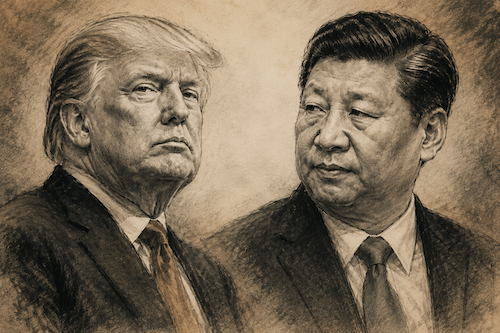
A Summit Described as Constructive, but Trade Announcements Fall Short of Expectations
The first meeting between Donald Trump and Xi Jinping in Beijing was described as positive by both delegations. The American president mentioned « fantastic » trade agreements, including a Chinese promise to purchase 200 large Boeing airplanes.
This announcement, however, disappointed some investors who had anticipated a wider commitment, around 300 aircraft, along with details about the models involved. The Chinese Ministry of Foreign Affairs adopted a significantly more cautious tone, merely referring to a consensus on certain common concerns and better international coordination.
This discrepancy between American communication and Chinese prudence fuels market skepticism about the real scope of the commitments made during this first day, in line with Donald Trump's visit to Beijing.
Strait of Hormuz: China at the Center of Diplomatic Expectations
Donald Trump claimed that Beijing had agreed to cease its deliveries of military equipment to Iran. He also stated that Xi Jinping wishes to help reopen the Strait of Hormuz, a strategic route for global oil transit.
These statements position China at the heart of the diplomatic efforts surrounding the Iranian crisis. However, no formal agreement or specific mechanism has been detailed, keeping the markets in a state of anticipation.
The price of Brent crude illustrates the lack of tangible de-escalation: the European benchmark has risen by 2.36% in twenty-four hours, reaching $109.11 a barrel. As long as no concrete evidence of traffic normalization in the strait emerges, geopolitical risk will remain priced in.
Inflation: Converging Signals from the US and Japan Weigh on Markets
In the United States, bond yields are rising sharply. The 2-year rate has surpassed 4%, while the 10-year Treasury yield reaches 4.52%, its highest level since May 2025, as reported by Henry Allen from Deutsche Bank, according to Les Echos. The latest producer price figures show a 6% year-on-year increase, and a 5.2% rise excluding food and energy, the highest level in more than three years.
Japan is sending a similar signal: its producer price index reaches 5%, its highest level since mid-2023. The Tokyo Stock Exchange reacted with a significant drop, with the Nikkei 225 falling by as much as 2.7% during the session before closing down 2%.
This inflationary trend is already evident in China according to the latest data on producer prices, fueling fears of a resurgence in global price pressures. European central bankers are thus considering a rate hike as early as June, according to several sources. The combination of expensive oil, persistent geopolitical tensions, and a potential tightening of monetary policies creates an unfavorable environment for stock markets, particularly for cyclical and technology stocks.
This content has been automatically translated using artificial intelligence. While we strive for accuracy, some nuances may differ from the original French version.


