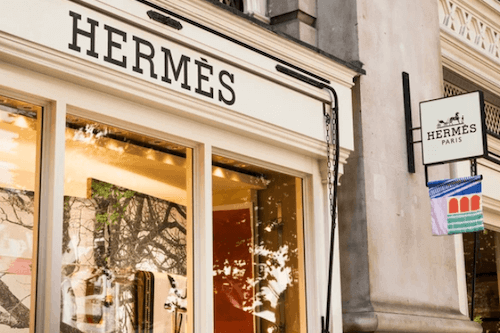
Hermès Shares Jump 3% but Remain Oversold After a Yearly Decline of 31%
On Wednesday, Hermès International's stock price reached 1,657.50 euros, marking an increase of 3.01% from the previous day's close of 1,609 euros. This surge occurs amidst a broader rebound of the CAC 40, which is up 2.08% during the session. However, over the past three months, the stock of the Parisian saddler has still declined by nearly 22%.
Wednesday's rise does not fundamentally alter the technical setup of Hermès International. The price, at 1,657.50 euros, remains significantly below its 50-day moving average of 1,957.84 euros, a gap of over 15% indicating the depth of the recent correction. The Relative Strength Index (RSI), a measure of the velocity and magnitude of price movements, is at 21, a level considered an intense oversold zone. An RSI below 30 generally suggests that selling pressure has been strong and that a technical rebound could occur, which appears to be the case today. Moreover, the stock has precisely rebounded from its support threshold at 1,609 euros, corresponding to the previous day's closing price. The major resistance lies at 2,118 euros, well above the current levels. Within the Paris-listed luxury sector, the day's dynamics are mixed: LVMH is up 1.52% while L'Oréal advances 1.92%, in a general market recovery movement in Paris.
Recent Analyst Perspectives on Hermès
Free · Every morning
Technical market signals, before the opening bell.
Bullish and bearish momentum, analyst changes, stocks to watch — automatically computed from Euronext data.
✓ Before 9 AM every morning✓ Euronext data✓ AI-powered analysis
You're in — subscription confirmed!
Your first edition is on its way. Check your spam folder and add us to your contacts.
An error occurred.
Indicative data. No investment advice. Unsubscribe at any time.
Gratuit · chaque matin
Ne ratez plus rien sur vos actions
La tendance derrière les cours. L'essentiel des valeurs Euronext en quelques minutes.
📈les valeurs en mouvement, sur la durée
🎯les objectifs d'analystes qui évoluent
📰les actualités qui font bouger les cours
tendance · 6 séances
✓ C'est fait, vous êtes inscrit !
Votre première édition arrive bientôt. Pensez à vérifier vos spams.
Une erreur est survenue.
CAC 40 · SBF 120 · données indicatives · aucun conseil en investissement · désinscription à tout moment.
On Sunday, March 30, two banks adjusted their outlooks on the stock. UBS significantly lowered its price target from 2,310 to 1,820 euros, while maintaining a neutral stance. This new target represents an approximate 9.8% upside potential from the current price. HSBC slightly reduced its target from 2,350 to 2,300 euros, maintaining a buy recommendation, indicating a rebound potential of nearly 39%. The notable difference between these two targets illustrates very different readings of the group's trajectory. These revisions precede an important date for the market: the publication of the first-quarter revenue on April 15, followed by the annual general meeting of shareholders two days later. These events could provide concrete insights into the resilience of demand in the luxury sector, in an environment characterized by high market stress, with the VIX reaching 31.05 at its last available reading. Over the year, the stock has recorded a decline of nearly 31%, marking one of the most significant corrections in its recent history.
Le modèle Hermès, fondé sur une distribution exclusive et qualitative, a une nouvelle fois porté ses fruits. Hermès aborde l’année 2026 avec confiance.
Résultats annuels 2025 solides: chiffre d’affaires de 16 002 millions d’euros, croissance à taux constants de 8,9 % et croissance à taux courants de 5,5 %. Résultat opérationnel courant de 6 569 millions d’euros (41,0 % du chiffre d’affaires) et résultat net de 4 524 millions d’euros. Cash flow disponible ajusté de 3 880 millions d’euros; trésorerie nette retraitée à 12 773 millions d’euros. Propositions de dividendes et actions nouvelles pour 2026, avec un accent sur le développement et l’emploi.
Outlook / guidance
Expected revenue: Le chiffre d’affaires 2026 est attendu en progression à taux constants sans chiffre précis communiqué.
Expected EBITDA: Non précisé dans le communiqué.
Expected net income: Non précisé dans le communiqué.
Management commentary: Perspectives positives pour 2026, grâce au modèle d’entreprise intégré et à la fidélité de la clientèle, malgré un contexte économique et géopolitique incertain.
The information presented in this article is provided for informational purposes only and does not constitute an investment recommendation, an incentive to buy or sell a financial asset, or investment advice. Readers are invited to conduct their own research before making any decision.
Investments in the stock market involve risks, including the risk of capital loss. Past performance of an asset or market is no guarantee of future results. Any investment decision should be made taking into account your personal financial situation, objectives and risk tolerance.