

Hermès Stock: 3.78% Decline Despite 10% Sales Increase in Q3
This Wednesday morning, Hermès unveiled its third quarter 2025 results, posting a revenue of 3.9 billion euros, a 10% increase at constant exchange rates compared to the previous year. Despite this solid performance, the stock of the luxury leather goods maker fell by 3.78% at midday, trading at 2,165 euros, while the CAC 40 index only dropped by 0.16%.
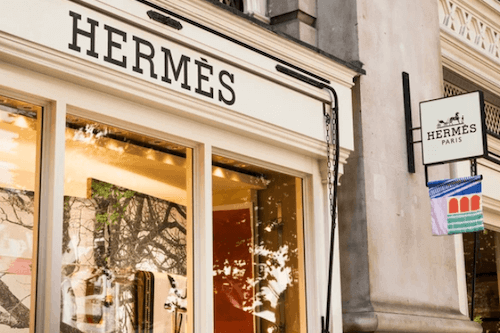
Hermès Stock Underperforms Despite Generally Satisfactory Results
Hermès stock significantly underperformed the Paris index this Wednesday, despite generally satisfactory results. This decline is part of a positive weekly dynamic, with the stock having risen by 6.86% over the last seven days. Over a longer horizon, the trend remains mixed: the stock has fallen by 7.04% over three months, but maintains a lead of 5.22% over one year, thus outperforming the CAC 40, which gained 9.41% over the same period. Trading volumes remain modest, with only 0.04% of the capital traded in the morning, reflecting a certain restraint from investors following these publications. The decline observed this morning seems linked to a slight disappointment in the leather goods and saddlery division, the core business of the group representing nearly 45% of total sales. Although this branch showed a growth of 13.3% at constant exchange rates, some analysts had expected a more marked progress, around 14%. Additionally, the current stock market context favors a repositioning of investors towards more discounted luxury stocks, at the expense of those perceived as defensive and already well-valued. This sector rotation partly explains this morning's movement, even though the group's fundamentals remain solid.
Technical Analysis of Hermès Stock
From a technical standpoint, Hermès stock is now above its technical support level at 2,026 euros, which gives it some leeway in case the correction continues. Conversely, the resistance level at 2,250 euros, breached the day before, was quickly abandoned this morning, marking a return below this symbolic ceiling. The 50-day moving average, established at 2,100.86 euros, confirms a short-term upward trend, with the current price remaining above this benchmark. However, the 200-day moving average, positioned at 2,358.56 euros, is significantly higher than the current price, indicating a relative weakening compared to the fundamental dynamics observed at the beginning of the year. The Relative Strength Index, or RSI, stands at 64, a level that reflects some dynamism without indicating an imminent overbought situation. An RSI above 70 would typically indicate overheating. Here, a value of 64 suggests that the stock still has potential for progression, while remaining in a technical neutral zone. The extremely low Beta, at 0.02, further confirms that Hermès stock moves almost independently of the CAC 40 movements, reinforcing its status as a safe haven within the luxury sector.
Volatility and Technical Indicators
The Bollinger Bands, which currently frame the prices between 1,996.75 euros and 2,239.95 euros, show a slight contraction of recent volatility. These bands help identify phases of price consolidation or expansion, and the current configuration suggests that the stock is moving within a relatively stable range, despite the jolts of the session. The MACD, a moving average convergence-divergence indicator, shows a value of 28.50 for the main line, while the signal line is at 14.13. The MACD histogram, positive at 14.37, indicates a favorable gap between these two components, which generally signals a bullish continuation in the medium term, even if Wednesday's movement temporarily slows this dynamic. The one-month volatility, measured at 10.67, remains moderate for a stock of this size, reflecting contained price variations compared to other sector stocks. The Average True Range, established at 40.43, confirms this reading by quantifying the average amplitude of daily movements. Finally, the Chaikin Money Flow, positive at 0.03, indicates a slight inflow of buying liquidity in recent sessions, although this signal remains faint and is not enough to counterbalance the selling pressure observed this morning. All these technical elements paint a mixed picture, where the fundamental robustness of the stock coexists with a short-term adjustment phase.


