

HRS: Heavy-duty vehicle hydrogen refueling in 6 minutes during trials with Toyota
Hydrogen Refueling Solutions reported, as part of the RHeaDHy project conducted with Toyota Motor Europe and ENGIE Lab Crigen, a test campaign on its dual-nozzle refueling technology intended for heavy-duty applications. The announcement is a continuation of work undertaken by the hydrogen infrastructure designer on heavy mobility.
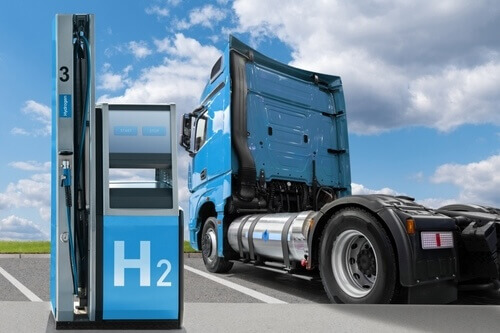
A test campaign conducted with Toyota and ENGIE on the dual nozzle
The Grenoble-based group conducted, alongside Toyota Motor Europe and ENGIE Lab Crigen, a test campaign on dual-nozzle refueling technology (Twin Nozzle) for heavy-duty vehicles. This approach aims to refuel trucks in reduced time, with the ambition of achieving diesel refueling performance, leveraging distribution technology derived from light vehicle applications.
These trials followed the integration of Mid Flow Twin technology components within an RHeaDHy distribution station, announced in January 2026. Over 6 days of testing, teams carried out 18 refueling tests across a wide range of operating conditions.
For example, with an ambient temperature of 30 °C, total refueling lasted 6 minutes (including connection, startup and final purge), for a quantity of hydrogen distributed equivalent to a range of up to 600 km for a heavy-duty vehicle. More than 400 kg of hydrogen were used during the campaign, of which 100% were recovered and recycled via the station after the tests.
The Mid Flow Twin protocol validated up to 40 °C
The campaign demonstrated the robustness of the ISO 19885-3 Mid Flow Twin refueling protocol, with a fill level (state of charge) consistently above 95%, even at ambient temperatures reaching 40 °C. This technology is based on a dual-nozzle architecture that reduces refueling times for both heavy and light vehicles, while optimizing installation and operational costs of stations.
The tests also highlighted the flexibility of the system, both in terms of distribution by stations and on-board vehicle storage, in dual-nozzle (Twin Nozzle) configuration as well as single-nozzle (Single Nozzle) configuration.
According to HRS, the partners will now seek to demonstrate these performances in the near future directly on a heavy-duty vehicle under real operating conditions.


