

Democratic Wave in the United States: AI Shaken in Asia, European Markets Hold Steady
Democrats will control both chambers of the U.S. Congress starting in January, according to NBC News projections. In Asia, artificial intelligence stocks led the decline on Wednesday amid fears of stricter regulation of data centers. Europe did not follow suit.
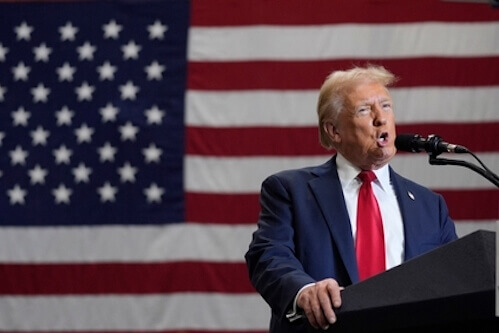
Democrats Retake Both Houses of Congress
The U.S. midterm elections have significantly altered the political balance in Washington. According to results reported by the Associated Press, the Democrats have gained the majority in both the House of Representatives and the Senate. They notably won elections in several states traditionally favorable to Republicans, including Texas, Kansas, and South Carolina.
For Donald Trump, this defeat means that the second half of his term will unfold with a legislature controlled by the opposition. In the House of Representatives, NBC News projected about 248 Democratic seats in an estimate published on November 4, while 218 are needed to secure the majority. This figure remains a projection, as several counts are still incomplete.
In the Senate, Democrats made a larger-than-expected gain, flipping seven Republican seats according to projections reported during election night. The magnitude of this change reflects the challenges faced by the Republican Party concerning purchasing power, economic policy, and foreign policy. The new Congress will take office on January 3, 2027. Until then, the presidential administration retains the same parliamentary interlocutors, but businesses and investors must already account for a significant change in U.S. legislative prospects.
Democratic Victory in Texas Puts Data Centers at the Heart of Concerns
Among the election results, the one in Texas particularly captures the attention of technology investors. Democrat Gina Hinojosa has defeated the incumbent Republican governor Greg Abbott, ending over thirty years of Republican dominance of the state's executive office. She also becomes the first Latina woman elected governor of Texas.
This victory comes as the state serves as a significant development hub for American IT infrastructure. Major tech operators have made substantial investments in computing capacities, power installations, and data centers essential for artificial intelligence applications. However, Gina Hinojosa has opposed the conditions under which these projects are proliferating. In her program dedicated to data centers, she advocates for a moratorium until legislative protections are adopted that would allow residents to influence decisions on site locations. She has also criticized the tax incentives granted to the sector under Greg Abbott.
Her campaign highlighted the potential impact of these installations on water resources and electricity supply. Nevertheless, the change of governor does not mean that existing projects will be automatically halted. Decisions will depend on the measures actually taken by Texas authorities, the laws passed, and the rights already granted to operators.
Why Artificial Intelligence Is Particularly Vulnerable
Market concerns are centered on the growing reliance of the artificial intelligence industry on investments in physical infrastructure. Behind the computer models and software lies an especially extensive industrial chain: chip manufacturers, server providers, cooling specialists, electrical equipment suppliers, and data center builders. A restriction on new establishments in the United States could slow down some projects or increase their implementation costs.
Companies that supply this equipment might then experience order delays, even if the final demand for computing power continues to grow. However, this transmission remains hypothetical: no generalized slowdown in investment spending can be deduced solely from electoral results. Investors also consider concerns prior to the election, regarding the valuations of tech companies and the future profitability of massive AI-related expenditures. Jesper Koll, expert director at Monex Group, suggests that the sector's dynamics had already deteriorated independently of the political majority in Congress. In his comments collected by Reuters, he points out that the criticisms and concerns surrounding artificial intelligence go well beyond partisan considerations. This distinction is crucial: the elections add regulatory uncertainty to a sector already subject to financial questioning, but they are not sufficient, on their own, to explain the entire stock market correction.
Tokyo and Taiwan decline, but Seoul manages to rebound
The Asian session on Wednesday, November 4, highlighted the sensitivity of tech stocks to these new uncertainties. In Tokyo, the Nikkei 225 ended down 1.42% at 62,188.63 points, after experiencing significantly larger losses during the day. The TOPIX index fell by 0.89%. Japanese suppliers in the semiconductor industry were among the penalized stocks.
According to data reported by Aju Press, Tokyo Electron dropped 3.42%, Advantest 3.35%, and SoftBank Group 3.20%. Kioxia fell 5.38%, in a context also marked by disappointing earnings prospects. In Taiwan, the TAIEX index lost 0.83%, closing at 42,948.91 points. TSMC declined by 1.53%, Foxconn by 2.24%, and Quanta Computer by 2.89%. These companies operate at various levels of semiconductor, component, or computer equipment production.
South Korea, however, avoided a negative closure. After a significant drop during the session, the Kospi rebounded to finish up 0.62% at 5,683.80 points. This recovery shows that the initial sales did not lead to a uniform decline in Asian markets. Investors gradually reassessed the political risk, while some industrial and tech stocks regained part of their losses.
In China, Monetary Support Outweighs American Concerns
The reaction of Chinese stock markets contrasted with that observed in Japan and Taiwan. In mainland China, the Shanghai Composite Index was up 1.44% at 3,660.38 points around 2 PM local time, while the Shenzhen Index gained 3.22%. The ChiNext Index, which is more exposed to growth companies, advanced by 4.78%. These movements occurred as Beijing strengthened measures to support its financial market.
According to Aju Press, the People's Bank of China lowered the rate applied to its refinancing mechanism for stock purchases and equity acquisitions by 0.25 percentage points to 1%. The goal is to facilitate financing operations likely to support stock prices. This intervention provided Chinese investors with a distinct buying motive separate from U.S. election results.
In Hong Kong, the Hang Seng also moved back into positive territory in the afternoon after declining at the beginning of the session. This divergence underscores that Asian markets do not react solely to events in Washington. National monetary decisions, corporate results, and local economic outlooks continue to influence their trajectories. It would therefore be reductive to attribute all regional variations solely to the Democratic victory.
European Markets Rise, Boosted by Banks and Renewables
Europe reacted differently to the American results. After initially unfavorable indications in futures contracts, the main financial markets opened in positive territory on Wednesday. The STOXX 600 index was up 0.5% at the open. The CAC 40 and DAX also rose, while Italy's FTSE MIB gained 1.2%. European banks contributed to the movement, with sectoral growth exceeding 2% at the beginning of trading.
Investors particularly sought out institutions more exposed to their domestic markets. Renewable energy stocks saw notable increases: Vestas was up 5%, Ørsted 7%, and Nordex 4.7% in early trading. These companies had been penalized by several of Donald Trump's energy policy directions.
The Democratic control of Congress now raises hopes of a less restrictive attitude toward certain low-carbon technologies. However, this anticipation should be distinguished from an actual regulatory change. Donald Trump retains his executive powers and veto rights. The rebound seen in Europe primarily reflects an adjustment in investors' expectations, rather than the announcement of new support measures already implemented.
Dollar Declines as U.S. Bonds Benefit from Uncertainty
The repercussions of the election extend beyond stocks. In the foreign exchange market, the US dollar fell on Wednesday to its lowest level in about a month. Simultaneously, the yield on the ten-year US Treasury bond dropped by nearly five basis points, to 4.915%. This movement reflects an increased demand for bonds and a reassessment of economic policy expectations. Investors particularly anticipate that a Democratic Congress might hinder some of the president's budgetary initiatives, reducing the likelihood of new spending or tax cuts.
A potential slowdown in digital infrastructure investments could also alter growth and inflation prospects. However, these assumptions remain uncertain, as negotiations between Congress and the White House could also result in costly compromises for public finances.
The easing of bond yields also presents a potentially favorable effect on stock valuations: when the rates used to discount future earnings decrease, the theoretical value of certain assets can increase, all else being equal. This mechanism helps explain why US futures gradually pared their losses after their initial reaction.
Political Gridlock in Washington: What Investors Will Be Watching
The central issue in the coming months will be the ability of the Democratic Congress and Donald Trump to find compromises on economic and budgetary legislation. Starting in January 2027, the Democrats will be able to control parliamentary committees and conduct investigations into the administration. Their majority in the Senate will also give them more influence over nominations that require confirmation. However, the president will retain his veto power, as well as significant prerogatives in trade and foreign policy.
Analysts are divided on the financial consequences of this power-sharing. Tai Hui, a strategist at J.P. Morgan Asset Management, believes that a divided government could help better contain deficits while noting that Donald Trump still holds significant influence over tariffs and existing regulations. Nick Ferres from Vantage Point Asset Management, on the other hand, identifies a risk of confrontation over the federal debt ceiling and increased scrutiny of the technology sector. Michael Arone, chief investment strategist at State Street Global Advisors, presents a less alarmist position: “I don’t think the big risk for markets comes from the blue wave, but from investors’ excessive reaction to that wave,” as he told Reuters. This analysis highlights the potential discrepancy between the immediate reactions of the markets and the actual economic effects of the election.
For investors, three issues will be particularly important: the future of American data center projects, upcoming budget negotiations, and the performance of companies exposed to artificial intelligence. The Democratic victory represents a significant political shift, but its financial impact will depend on the decisions actually made in the coming months.
This content has been automatically translated using artificial intelligence. While we strive for accuracy, some nuances may differ from the original French version.


