

G7 in France: The West Prepares Its Response on AI and Critical Minerals
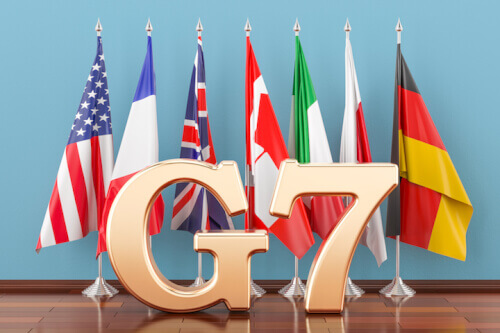
Critical Minerals: The Supply Chain as a Geopolitical Priority
The most structuring aspect of the summit involves securing supply chains for rare earths and permanent magnets, which are currently dominated by China. Last month, the G7 trade ministers expressed « serious concerns » over the use of export restrictions as a tool of economic coercion and are considering the creation of a permanent unit dedicated to critical minerals within the International Energy Agency.
The agenda also includes coordinating investment policies and public aid to build Western value chains in rare earths. This direction aligns with the assessment made by the European Banking Federation, which estimates that the European Union requires an additional €1.4 trillion in annual investments.
The challenge lies in a long cycle of relocation and cross public subsidies, from which Western mining industries, permanent magnet manufacturers, and refining actors could benefit over several years.
AI: Washington Lays the Foundation for a Federal Cybersecurity Framework
A U.S. decree signed in early June establishes a voluntary cybersecurity review for certain AI models before they hit the market and plans for the creation of a federal « one-stop shop » on vulnerabilities related to these technologies. Some experts cited consider this approach still too lenient, but it represents the first American attempt at a cross-cutting framework on the security of advanced models.
The Trump administration aims to leverage the G7 to rally its allies around a common approach, presented as a technological leadership lever against China. The issue directly intersects with access to advanced semiconductors, energy for data centers, and critical minerals required for AI infrastructure.
For investors exposed to advanced technologies, the emergence of a federal regulatory framework, even if non-binding, can clarify the operational environment for model developers and specialized cybersecurity providers, while also introducing additional compliance costs.
Monetary Backdrop: ECB Takes a Tougher Stance, U.S. Inflation Takes Hold
The summit opens in a macroeconomic environment significantly less favorable than six months ago. The ECB raised its deposit rate by 25 basis points to 2.25% on June 11, marking its first increase since September 2023. Eurozone inflation was at 3.2% year-on-year in May according to Eurostat, with revised central projections of 3.0% for 2026, 2.3% in 2027, and 2.0% in 2028.
In the United States, CPI inflation reached 4.2% year-on-year in May according to the Bureau of Labor Statistics, with a core component at 2.9%, while the final demand PPI climbed 6.5% year-on-year, the largest annual increase since November 2022. Brent crude is trading around $88 on June 12, declining after Donald Trump's statements suggesting a potential easing with Iran, compared to $92.98 the previous day.
These levels remain extremely sensitive to the progress of negotiations between Washington and Tehran: failure or a major military incident could abruptly reverse the observed easing. Similarly, expectations on the trajectory of the Fed and ECB can quickly change with upcoming releases. For investors, this dual equation of G7 geopolitical coordination on one hand and monetary tightening and energy uncertainty on the other defines the framework within which long-term sectoral arbitrages are now made.
This content has been automatically translated using artificial intelligence. While we strive for accuracy, some nuances may differ from the original French version.


