

Brent Crude Approaches $100 Again: Strait of Hormuz Remains Paralyzed
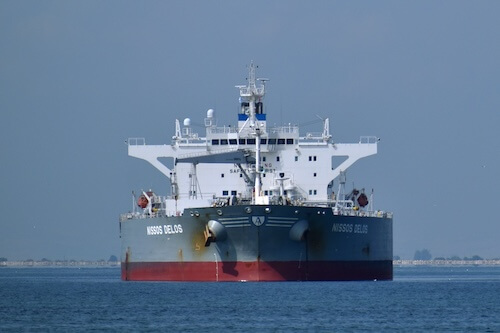
307 Transits Instead of Thousands: Slowdown in the Strait of Hormuz
Between March 1 and April 7, only 307 passages of ships carrying raw materials were recorded in the Strait of Hormuz, according to data from Kpler relayed by Reuters. Normally, this chokepoint sees several thousand ships over an equivalent period. The drop, estimated at around 95%, constitutes a logistical disruption of a rarely observed magnitude on this essential maritime route for global energy trade.
The origin of this near paralysis is military in nature. Iranian media, citing an official statement, indicate that ships must, until further notice, take alternative routes in close coordination with the Islamic Revolutionary Guard Corps Navy. The stated goal is to avoid possible collisions with mines whose exact location has not been made public.
This security measure transforms a normally smooth passage into a marked and constrained route, significantly lengthening transit times. Shipowners, faced with this uncertain operational framework, are awaiting further clarification before considering a return to usual routes.
Furthermore, passage may now incur a fee: according to reports by the Financial Times, Hamid Hosseini, spokesperson for the Iranian Oil Exporters' Union, indicated that Tehran might impose a transit fee on tankers passing through the Strait of Hormuz, with payment in cryptocurrency up to 2 million dollars per ship. For now, however, the situation remains very unclear.
The absence of a precise timeline for lifting these restrictions keeps the entire oil and gas logistics chain under significant pressure.
A Fragile Ceasefire Undermined by Disagreement Over Lebanon
The announcement of a ceasefire between the United States and Iran could have signaled a détente for the markets. Talks are scheduled for Friday, April 10 in Islamabad, according to Reuters. However, Tehran quickly deemed these negotiations « unreasonable, » calling into question the conditions for resuming dialogue.
The sticking point concerns the geographical scope of the truce. Iran demands that the ceasefire explicitly include Lebanon, where the military situation has suddenly worsened. Israel, on the other hand, has stated that Lebanon is not included in the agreement reached with Washington. This fundamental disagreement prevents any concrete progress toward regional de-escalation.
On Wednesday, the Israeli army conducted new strikes on Lebanese territory. These military operations have directly compromised the budding diplomatic dynamic. By conditioning the continuation of talks on Lebanon's inclusion in any agreement, Tehran sets the bar at a level that Israel currently refuses to consider, creating an impasse with consequences that extend far beyond the diplomatic sphere.
Brent at $98.30: Anatomy of a Surge
While it had dropped by more than 16% in just a few hours, the price of a Brent barrel bounced back from 93 to 98.30 dollars in a single session, nearing the symbolic 100-dollar mark this morning. This increase of over 5% in twenty-four hours reflects the conjunction of two factors: a massive physical supply restriction due to the blockade of the Strait of Hormuz and geopolitical uncertainty without any credible short-term resolution.
The mechanism is directly tied to logistical realities. When 20% of global crude oil and LNG can no longer follow their usual routes, the entire market reassesses the supply risk. Alternative routes, which are longer and more costly, do not compensate for the lost fluidity. Each additional day of blockage increases freight costs and reduces the volumes actually delivered to refineries.
The lack of visibility on the duration of this disruption fuels the speculative component of the price. Operators factor into their expectations the scenario of a prolonged blockade, especially since the announced truce between Washington and Tehran has led to no tangible improvement in the strait. As long as shipowners refuse to resume traditional routes, upward pressure on prices will remain structurally supported.
Why Shipowners Remain Anchored
The caution exercised by shipping companies is often an underestimated indicator of the severity of a crisis. A diplomatic ceasefire is not enough to reassure operators when their ships, crews, and cargoes represent hundreds of millions of dollars in exposure. The confirmed presence of mines in the Strait of Hormuz imposes a level of risk that is incompatible with usual insurance standards.
Maritime insurers, who base the coverage of ships on a precise assessment of danger, have not yet reclassified the area as an acceptable risk. Without this reclassification, the additional premiums remain prohibitive, and shipowners have no economic incentive to return to traditional routes. Compulsory coordination with the Revolutionary Guards' navy adds a layer of operational complexity that many prefer to avoid.
This situation creates a cycle where logistical paralysis maintains pressure on prices, which in turn reinforces the perception of a crisis and discourages any early resumption of traffic. Only an official lifting of navigation restrictions, accompanied by verifiable mine-clearing operations and a diplomatic agreement perceived as strong, could counter this dynamic. At this stage, none of these three conditions is met.
This content has been automatically translated using artificial intelligence. While we strive for accuracy, some nuances may differ from the original French version.


