

Safran selected for three French nuclear deterrence navigation programmes
Safran Electronics & Defense announced on 2 November 2026 that it had been selected this year for three inertial navigation programmes of the French nuclear deterrence. Its hemispherical resonator gyro (HRG) technology will equip three of the main delivery systems. This presence extends more than fifty years of commitment by the subsidiary to this force.
Third-generation SSBN and M51.4 missile equipped with HRG
The first programme concerns the ballistic missile submarines (SSBN). The Global Navigation System (SGN) of the third-generation SSBN is expected to enable very long periods of autonomous navigation, without GNSS resynchronisation. According to the press release, this capability is central to the mission of a submarine deprived of any satellite signal underwater.
This new system will succeed the SGN-3EV from Safran Electronics & Defense, in service on the Triomphant-class SSBNs. The second programme concerns the M51 missile, for which the subsidiary already designs and produces the inertial unit of the current versions.
For the M51.4, which will equip the 2G and 3G SSBNs, the CI4 inertial unit will rely on dual-core HRG technology. The stated objective is to provide increased accuracy to the missile within a significantly more compact footprint.
Rafale F4 and HRG production increased to 30,000 units by 2032
The third programme targets the Rafale: dual-core HRG technology will equip a majority of the aircraft of the fifth production batch, in the F4 standard. On the aircraft carrier Charles de Gaulle, the navigation unit from Safran Electronics & Defense serves as a reference for aligning the Rafale navigation systems at sea before each mission.
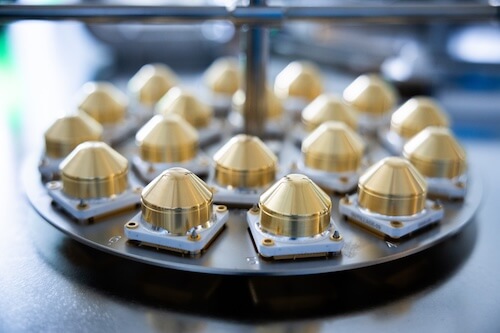
The HRG is designed and produced in France. Safran Electronics & Defense states that it invested 120 million euros this year in its French industrial capabilities, which currently produce 10,000 HRGs per year and will produce 30,000 by 2032.
Firing of an M51.3 from Le Vigilant on 6 October 2026
On 6 October 2026, off the Finistère coast and in the presence of the President of the Republic, the nuclear submarine Le Vigilant successfully fired an M51.3 missile. This test aimed to validate the operational capability of the SSBN after its periodic unavailability for maintenance and repair (IPER).
On board, the SGN-3EV system and the new BELUGA high-precision clock provided the submarine with its exact position and time, while the inertial unit guided the missile. The ICARE radar transponders and the RGNSS receiver, carried aboard for the test, made it possible to track the trajectory from the test centre.
Franck Saudo, Chairman of Safran Electronics & Defense, highlighted “the confidence renewed by the DGA since 1972 in Safran’s navigation and timing solutions”. He attributed this to the teams and to the subsidiary’s 58 industrial and technological sites.


