

Budget 2027: Markets Lose Confidence in France
Euro Dragged Down by French Concerns
Tensions persisted Monday morning in the foreign exchange market. During the Asian session, the euro fell to $1.1161, its lowest level since May 2025. The single currency then hovered around $1.118. French difficulties are not the only factor: the dollar is also benefiting from consistently high U.S. yields and its status as a safe haven. However, concerns about France's budgetary trajectory and the risk of contagion to other European bond markets have directly weighed on the euro. The pressure is even greater as the yield on the French 10-year government bond approached 5% last week, extending tensions already observed on the eve of the budget presentation. This movement is not limited to France: global bond markets are also experiencing a severe correction phase, amid rising inflation expectations and interest rate hikes.
A 43 Billion Euro Budget That Still Fails to Reassure
In this context, the government presented its budget plan for 2027 on Thursday, October 1st. The executive aims to reduce the public deficit from the 5.4% of GDP expected this year to 5% next year. The Finance Bill and the Social Security funding plan include 43 billion euros in corrective measures as part of a broader effort.
Nonetheless, the trajectory remains very strained. After reaching an anticipated 119.3% of GDP in 2026, public debt is projected to reach 121.7% of GDP in 2027, according to government forecasts reviewed by the High Council for Public Finances.
The interest burden is expected to continue rising sharply.
The budget provides for both savings and additional taxes. Measures include limiting the increase of certain pensions, reducing some tax benefits granted to retirees, savings in healthcare, and several tax hikes.
The Real Risk Remains Political
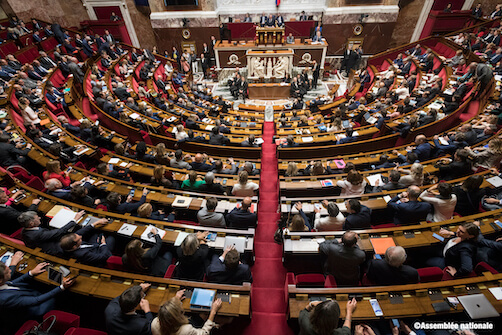
Beyond the numbers, it's now the government's ability to pass its bill that is worrying the markets. The Budget Bill was submitted to the National Assembly on October 1 and is set to be reviewed in a Parliament where the executive lacks a stable majority.
The opposition parties have already announced their intention to profoundly modify the proposal. The Republicans are contesting several tax increases, particularly those targeting retirees and certain sources of income. The National Rally considers the budget « insincere, » while the Socialist Party is calling for a corrective letter.
This political fragmentation is precisely one of the main concerns of Moody's. In an analysis published on October 2, the rating agency expressed pessimism about the evolution of the French political and economic situation and the possibility of the different parties quickly reaching a budgetary compromise.
US Rates Reach Highest Level Since 2002
However, France is far from being the only country facing soaring financing costs. The yield on the ten-year U.S. Treasury reached approximately 5.34% last week, its highest level since 2002, before easing to around 5.26% on Monday. The bond market correction is also affecting Germany, the United Kingdom, and Japan.
This widespread increase in rates complicates the understanding of the French case: part of the tension on French government bonds (OATs) stems from the global bond sell-off. However, the much more pronounced widening of the spread with Germany indicates that a specifically French risk premium has been added.
Oil Adds Extra Pressure
Markets must now contend with Brent crude consistently above $100. On Monday morning, a barrel was trading around $101.6, slightly down following the announcement of a strategic reserve release by the G7 and with increased crude exports from the Middle East.
However, prices remain supported by the conflict between the United States and Iran and the disruptions affecting the region's oil flows.
Rising energy prices fuel inflation expectations, which in turn help keep global bond yields at elevated levels.
For France, the issue is thus twofold: it faces a global rise in the cost of money just as its own public finances and a lack of parliamentary majority lead investors to demand a growing risk premium.
The next step will be political: the budget review in the National Assembly must now show if a compromise is possible or if the concerns that have pervaded the markets in recent days are set to persist.
This content has been automatically translated using artificial intelligence. While we strive for accuracy, some nuances may differ from the original French version.


