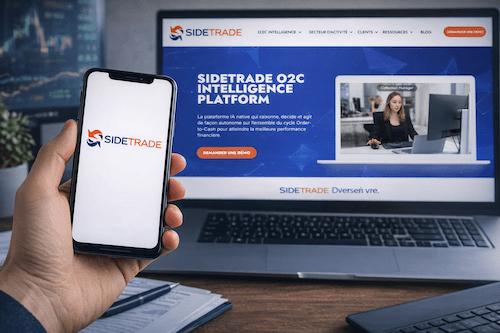
Sidetrade Targets 30 to 35% EBITDA by 2030 Through Its Agentic Model
On Tuesday, Sidetrade was recognized by The Hackett Group for its agentic operational model, a complete overhaul of its organization around AI agents. The Order-to-Cash specialist applies internally the same philosophy it markets to its clients, aiming for an EBITDA margin of 30% to 35% by 2030.
The core of this transformation lies in PodFlow, an R&D model built in 2025 and now applied across the company. In an initial pilot, a team of three delivered what previously required a team of six, while functionalities that once took 80 man-days to develop are now completed in three days. Sidetrade's 22 R&D teams now operate according to PodFlow, and the program has recouped its investment cost within six months. In this architecture, AI agents validate problems, generate specifications, write code, execute tests, and prepare documentation. Developers have shifted from an execution role to one of oversight, validation, and governance of what the agents produce. No feature enters the R&D pipeline without a validated problem, and none exits without complete documentation.
Expansion Across the Entire Organization
Free · Every morning
Technical market signals, before the opening bell.
Bullish and bearish momentum, analyst changes, stocks to watch — automatically computed from Euronext data.
✓ Before 9 AM every morning✓ Euronext data✓ AI-powered analysis
You're in — subscription confirmed!
Your first edition is on its way. Check your spam folder and add us to your contacts.
An error occurred.
Indicative data. No investment advice. Unsubscribe at any time.
Gratuit · chaque matin
Ne ratez plus rien sur vos actions
La tendance derrière les cours. L'essentiel des valeurs Euronext en quelques minutes.
📈les valeurs en mouvement, sur la durée
🎯les objectifs d'analystes qui évoluent
📰les actualités qui font bouger les cours
tendance · 6 séances
✓ C'est fait, vous êtes inscrit !
Votre première édition arrive bientôt. Pensez à vérifier vos spams.
Une erreur est survenue.
CAC 40 · SBF 120 · données indicatives · aucun conseil en investissement · désinscription à tout moment.
The agentic model now extends to every business function of Sidetrade, beyond engineering. Each transformation phase is self-financed by the savings from the previous phase. The company targets a productivity gain of 20% by 2026, with further improvements expected in 2027. The resources freed up will be reinvested to enhance the customer experience. This operational transformation also meets the growing expectations of corporate buyers, who increasingly expect software vendors to apply the AI technologies they advocate to their own activities. Sidetrade integrates the six categories of AI activators defined by The Hackett Group (predictive, conversational, insight, workflow, cognitive, and content) into its daily production.
SectorServices aux entreprises · Services numériques›Logiciels
Free · every morning · before 9am
Never miss a move on your stocks
The trend behind the prices · Euronext
✓ You're in! Check your spam folder.
An error occurred.
Context
Period
Period: 2T2026
Key reported figures
Revenue: 18.0M€
Guidance from the release
« Le premier semestre 2026 est tout simplement le meilleur de notre histoire. »
Risks mentioned
Le manque de visibilité sur les prix du MTok pourrait freiner le déploiement de l’IA.
Pression due à l'impact des prises de commandes en retrait enregistrées en 2025.
Opportunities identified
Record de nouveaux abonnements récurrents au T2 2026 avec 3,11 M€.
Lancement commercial des produits IA native dès le deuxième trimestre 2026.
Le trimestre devient le plus prolifique de l’histoire de Sidetrade.
The information presented in this article is provided for informational purposes only and does not constitute an investment recommendation, an incentive to buy or sell a financial asset, or investment advice. Readers are invited to conduct their own research before making any decision.
Investments in the stock market involve risks, including the risk of capital loss. Past performance of an asset or market is no guarantee of future results. Any investment decision should be made taking into account your personal financial situation, objectives and risk tolerance.